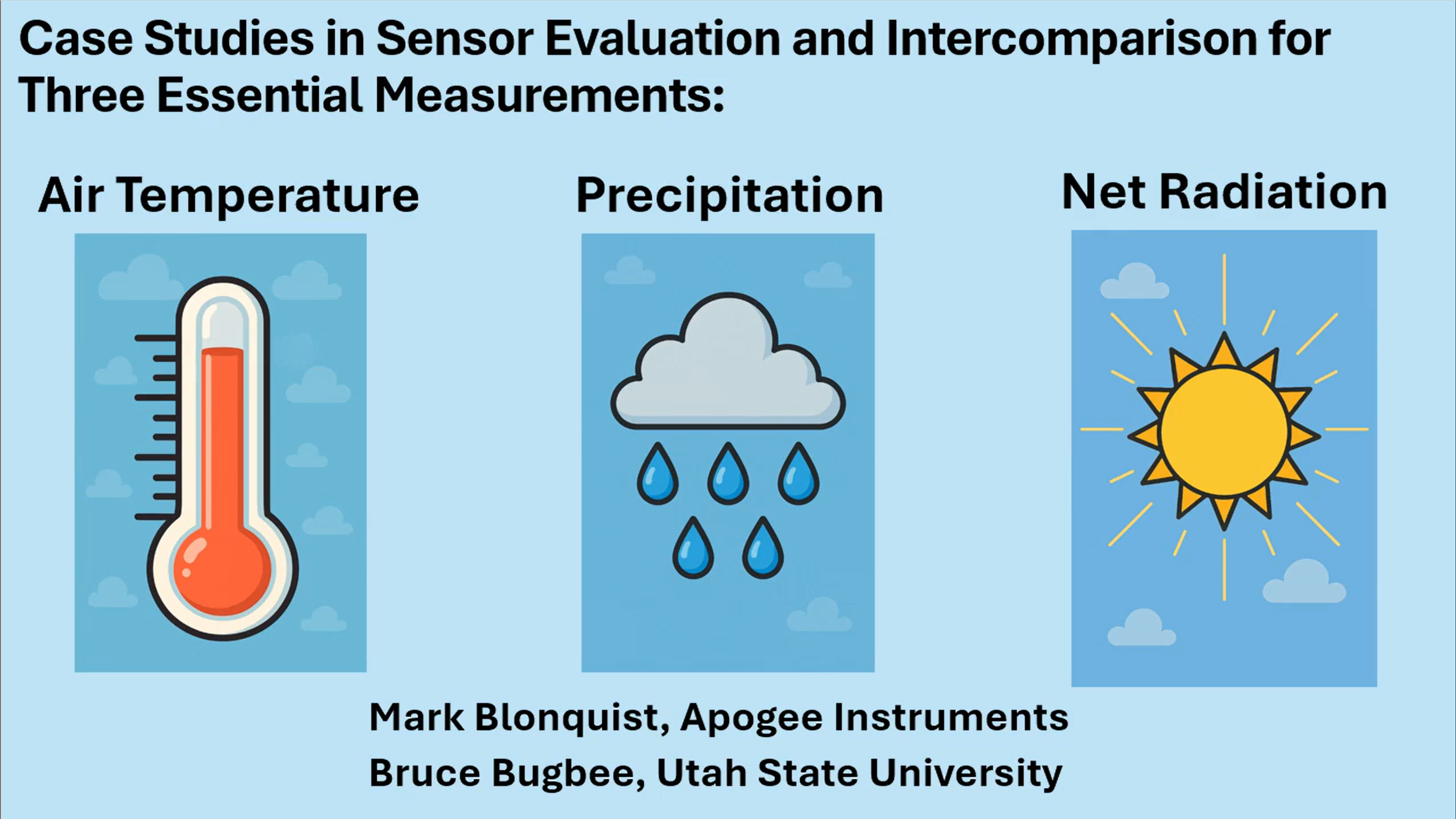
Presentation on Sensor Evaluation and Intercomparison for Air Temperature, Precipitation, and Net Radiation
Presentation given at CANVAS convention on November 11, 2025. Watch the talk now >
Key takeaways from the presentation:
- An indirect method for evaluating air temperature accuracy
- A straightforward approach for checking precipitation gauge calibration
- Ways to use models and complementary measurements to assess net radiation performance
- Which sensors or measurement methods work best for air temperature, precipitation, and net radiation
Air temperature, precipitation, and net radiation sit at the foundation of agricultural and ecological research. They inform irrigation decisions, energy balance models, crop simulations, and long-term climate analyses. But how can users worldwide be sure these measurements are correct?
Unlike some physical quantities, there is no single, universally accepted primary reference standard for these variables in field conditions. That makes accuracy less straightforward than many assume. Establishing confidence in these measurements requires thoughtful calibration strategies, creative verification techniques, and carefully designed sensor intercomparisons.
In this talk, Mark Blonquist (Apogee Instruments, Chief Scientist) shared insights from field studies that directly compare instruments measuring temperature, rainfall, and net radiation. Those findings are valuable to researchers, instrument developers, and commercial users. He presents information that answers questions around which approaches produce the most reliable data and identify what contributes to those approaches working well. He also offers best practices for lowering measurement uncertainty in the field.