JavaScript is required to run this calculator. Your browser either does not support JavaScript, or has JavaScript turned off.
  Loading... Please wait...

Our Newsletter


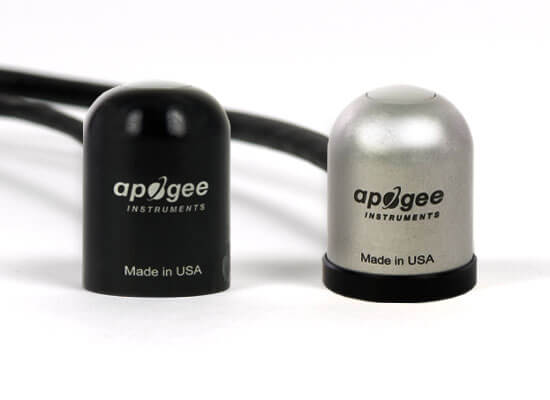
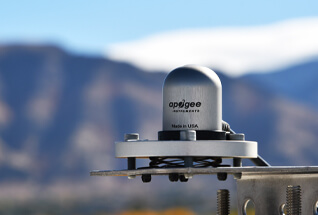
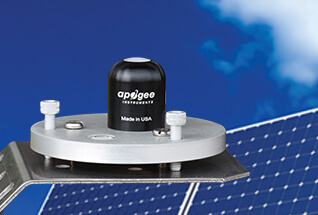
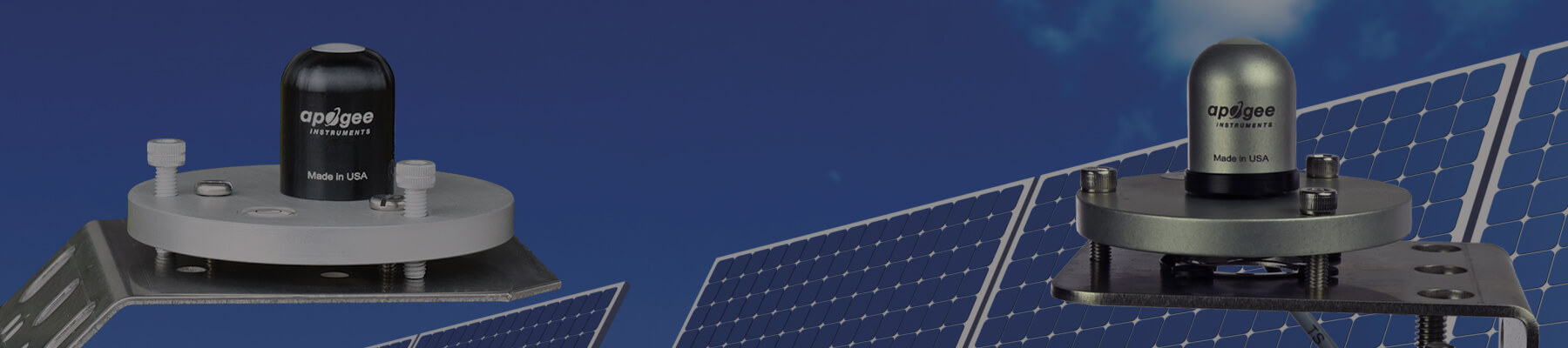
Apogee Pyranometer Technical Information

Apogee Instruments Pyranometer Cosine diagramCosine Response

A cosine corrected pyranometer sensor is designed to maintain its accuracy when radiation comes from different angles. For pyranometers, the test of cosine response is to measure extreme zenith angles. The cosine response of Model MP-200 at 75° is ± 4 percent, see diagram at right and graph below. Zenith angles greater than 75° contribute less than 3 percent of daily radiation. The ideal cosine response in a vacuum is shown in red in the graph below. The CM21 and Apogee MP-200 deviate from the ideal due to humidity and particulate matter in the atmosphere.

Pyranometer Cosine graph

The pyranometer is calibrated to provide an output of exactly 0.2 mV per W m-2. The output of all radiation sensors tends to decrease over time as the detector ages.Recalibration

The pyranometer is calibrated to provide an output of exactly 0.2 mV per W m-2. The output of all radiation sensors tends to decrease over time as the detector ages.

The need for recalibration varies. For continuous outdoor use, we recommend that you send your sensors in every 2 years for recalibration. Do not attempt recalibration without a radiation standard.

Visit our recalibration section for info on how to request an RMA to send in your pyranometers for recalibrating.

A thermopile pyranometer measures all of the energy between 280 and 2800 nm. However, about 90% of the sunlight energy is between 300 to 1100 nm so silicon-cell photodiode pyranometers can be calibrated to estimate all of the shortwave energy from sunlight.Spectral Response

A thermopile pyranometer measures all of the energy between 280 and 2800 nm. However, about 90% of the sunlight energy is between 300 to 1100 nm so silicon-cell photodiode pyranometers can be calibrated to estimate all of the shortwave energy from sunlight.

Note on Use of Apogee Pyranometer

All silicon-cell photodiode pyranometers sub-sample the shortwave radiation spectrum (from 300-1000 nm), and are calibrated to predict all of the solar radiation (from 280 to 2800 nm). For this reason, they should only be used to measure unobstructed solar radiation. The pyranometers should not be used to measure electric lights, under canopies of vegetation or to measure reflected radiation.

Increasing temperature decreases the output of most silicon-cell photodiodes. Our measurements indicate that temperature errors are less than 1% between 5 C and 40 C. The temperature error is insignificant for most applications.Temperature Response

Increasing temperature decreases the output of most silicon-cell photodiodes. Our measurements indicate that temperature errors are less than 1% between 5 C and 40 C. The temperature error is insignificant for most applications.

Apogee Instruments PyranometersLong-Term Test Results

The Utah State University Crop Physiology Lab has conducted a long-term outdoor pyranometer study for the past 10 years.

Their results are available below and show that the Apogee pyranometers compare well to other silicon-cell photodiode and thermopile pyranometers. Each model is compared to a heated and ventilated Kipp and Zonen CM21 thermopile pyranometer.

View silicon-cell photodiode pyranometer results.

View thermopile pyranometer results.

Production of the Apogee Instruments PyranometersMore Information on Shortwave Radiation

The American Society of Agronomy recently published a comprehensive reference book on environmental instrumentation. The book, entitled "Micrometeorology in Agricultural Systems," is available from the Agronomy Society.

This book includes a chapter on the principles and challenges of measuring shortwave radiation written by Steve Klassen and Bruce Bugbee.

Cosine Response

This graph shows typical Apogee cosine response relative to the K&Z CM21.

Apogee has devoted significant resources to improving the cosine response of our pyranometers. These efforts have been rewarded by independent verification from the Broadband Outdoor Radiometer Calibration (BORCAL) test results at the National Renewable Energy Laboratory (NREL) in Boulder, Colorado.

In June of 2005 NREL confirmed that all six replicate Apogee sensors (model SP-110) exceeded our specification for cosine response (±1 percent at 45° Zenith angle, ±5 percent at 75°).

Results of these tests are available from NREL and are shown here along with a sampling of three thermopile (black body) pyranometers and two other silicon cell pyranometers.

These tests have also shown that the CM21 has excellent cosine response. NREL normalizes all of the cosine error data to zero error at 45 degrees, which is the approximate average sun angle at most latitudes.

Because of its good cosine response, the SP-110 reads accurately throughout the day as the sun angle changes from dawn to solar noon to dusk. This accuracy is maintained as sun angles change from summer to winter. Sensors with poor cosine response can be calibrated so that they will accurately measure daily total radiation when the sun angle is the same as the day of calibration, however, they will not be accurate at different times of the year.

This figure shows the magnitude of seasonal changes in sun angle in Logan, Utah. Seasonal changes result in a 23.5° variation in solar angle between the solstice and equinox and 47° between the winter and summer solstices. For example, the zenith angle in Logan, Utah at solar noon varies from 18.3° on June 22 to just 65.2° on December 22. Remember that 0° is directly overhead.

Cosine response is synonymous to the term Lambertian response. Lambert’s Cosine law states that radiation intensity on a flat surface decreases as the angle of the surface decreases from perpendicular (normal or 0° zenith angle). This is expressed as: Eθ = E ∗ cos(θ)

All radiation sensors have some azimuth error, which shows up as the difference between the am and pm response. This error is typically smaller than the cosine error. To minimize azimuth error we calibrate Apogee sensors with the lead wire pointing north (in the Northern hemisphere) and we recommend mounting the sensor with the wire pointing towards the nearest pole. Most of the azimuth error is thus corrected in the calibration.

THE CASTLE DESIGN A flat sensor surface (without cosine correction) reflects radiation at low angles and under-weights low angle radiation. A sensor with a raised white diffusion disk over-weights low angle radiation. The traditional approach to achieving a good cosine response is to build a sensor with a raised, white disk, and then add a raised wall around the perimeter to block low angle radiation (this is called the castle design). This is an effective design, but it traps water and dust, which block light and result in low readings. The Apogee sensor uses a domed top to repel water and dust. This makes the sensor self cleaning. Accurate cosine response is achieved by having just the right amount of curvature on the dome, as well as using an appropriately opaque diffuser.