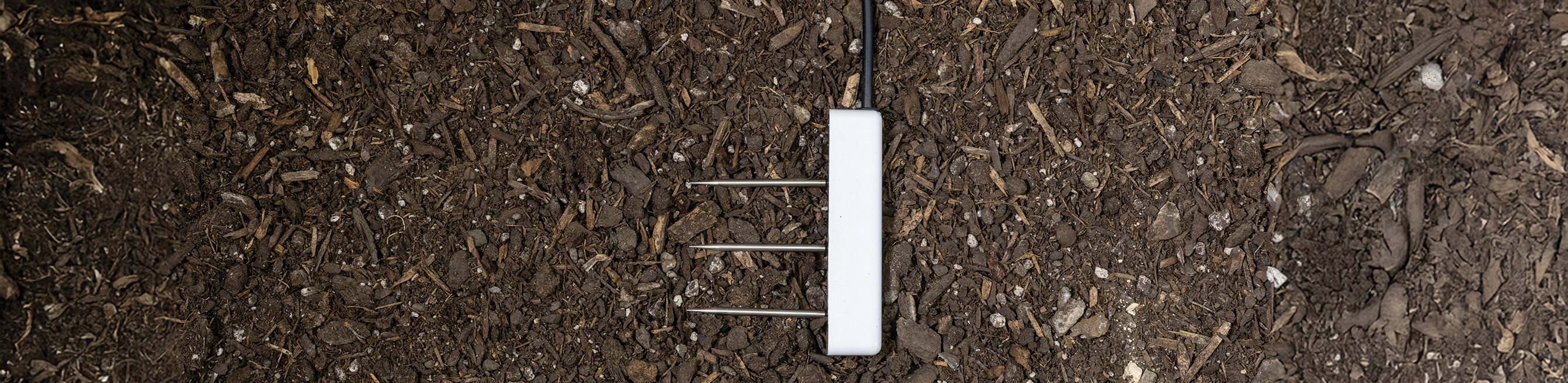
| TEROS12-MB | |
|---|---|
| Input Voltage Requirement | 5-24 V2 of leaf surface |
| RS-232 Current Draw | Minimum: 14.0 mA, Typical: 14.6 mA, Maximum: 37.0 mA |
| RS-485 Current Draw | Minimum: 9.0 mA, Typical: 9.6 mA, Maximum: 48.0 mA |
| Volumetric Water Content Range | Mineral Soil Calibration: 0.00-0.70 m3/3, Soilless Media Calibration: 0.0-1.0 m3/3, Apparent Dielectric Permittivity: 1 (air) to 80 (water) |
| Volumetric Water Content Resolution | 0.0010 m3/3 |
| Volumetric Water Content Resolution | Generic Calibration: ± 0.03 m3/3 (± 3.00% VWC) typical in mineral soils that have solution EC <8,000 µS/cm
Medium Specific Calibration: ± 0.01-0.02 m3/3 in any porous medium Apparent Dielectric Permittivity: 1-40 (soil range), ± 1 (unitless) 40-80, 15% of measurement |
| Output | Modbus (RS-232 and RS-485) |
| Temperature Measurement Range | -40 to +60 C |
| Temperature Resolution | 0.10 C |
| Temperature Accuracy | ± 1.0 C from -40 to 0 C, ± 0.5 C from 0 to +60 C |
| Dielectric Measurement Frequency | 70 MHz |
| Electrical Conductivity Range | 0-20,000 µS/cm (bulk) |
| Electrical Conductivity Resolution | 1 µS/cm |
| Electrical Conductivity Accuracy | +/- (5% + 10 µS/cm) from 0-10,000 µS/cm
+/- 8% from 10,000-20,000 µS/cm |
| Volume of Influence | 1010 mL |
| Sensor Dimensions | 9.4 cm length, 2.4 cm width, 7.5 cm height, 5.5 cm needle length |
| Mass | 171.5 g (with 5 m of cable) |
| Operating Environment | -40 to +60 C |
| Cable | 5, 10, or 20 m of four conductor, shielded, twisted-pair wire; customized cable lengths available; TPR jacket (high water resistance, high UV stability, flexibility in cold conditions); pigtail lead wires |
| Warranty | 3 years against defects in materials and workmanship |
| Compliance Assessment Standards | EN 61326-1:2013, EN 63000:2018 |
| Union Harmonization Legislation Conformity | 2014/30/EU, 2011/65/EU, 2015/863/EU |
This is a new product; there are no case studies yet. Check back again for new case studies. Applications include:
• Irrigation scheduling & management
• Monitoring soil health in natural environments, mineral soils, potting media, soilless substrates, and greenhouses.
• Analyzing fertilizer, salt, and solute movement
• Multi-depth profiling
If you would like to share your application of this product, please click here
What should I do if my sensor is reading too low?
• Check for air gaps around sensor needles. These could be produced below the surface of the substrate when the needle contacts a large piece of material and pushes it out of the way, or if the sensor is not inserted perfectly linear.
• Ensure the needles are not in contact with or very close to large, non-soil objects, like a plant pot wall.
• Ensure the calibration equation being used is appropriate for the media type. There are significant differences between substrate calibrations, so be sure to use the one specific to the substrate.
What should I do if my sensor is reading too high?
Check to make sure that the media was not packed excessively or insufficiently during sensor installation. Higher density can cause sensor reading to be elevated.
• Ensure the calibration equation being used is appropriate for the media type. There are significant differences between calibrations, so be sure to use the one most suitable to the substrate, or consider developing a substrate-specific calibration for the particular medium.
• Some substrates have an inherently high dielectric permittivity (soils of volcanic origin or high titanium, for instance). If the substrate has a dry dielectric permittivity above 6, a custom calibration may need to be performed. Soils with a bulk EC greater than 10 dS/m require substrate specific calibrations (see the Maintenance and Recalibration section).







 Helpful Articles and Links
 FAQs
FAQs